
Cube sugar production plants
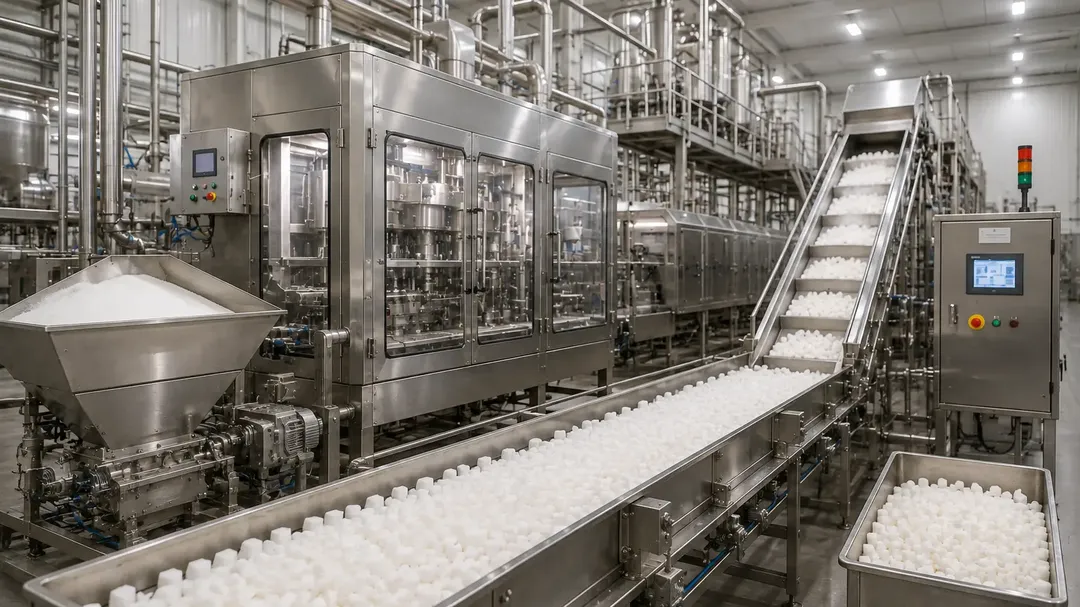
Cube sugar production plants utilize sophisticated machinery to compress granulated sugar into uniform cubes, employing hydraulic pressure or mechanical force to achieve precise shaping. Controlled moisture content and temperature during molding ensure structural integrity. Advanced drying techniques, such as hot air or infrared radiation, eliminate moisture, optimizing cube hardness and preventing clumping. Automated packaging systems maintain hygiene standards and facilitate efficient distribution of the finished product.
Cube sugar production plants are industrial facilities designed to convert granulated sugar into cube-shaped sugar — a convenient and popular form used in coffee and tea as well as in baking and cooking. Downstream, cube sugar is used in coffee and tea, baked goods, cocktails, desserts and confectionery, which makes the plant a supplier to households, restaurants and other food service establishments as well as to retail.
The process runs in five stages. Syrup preparation mixes granulated sugar with water and heats it to create a syrup, which is filtered to remove impurities and pumped into a batch vacuum pan. Crystallization boils the syrup under vacuum, so it boils at a lower temperature and caramelization is prevented; as the syrup concentrates, sugar crystals form and the mixture is transferred to a crystallizer where agitation promotes crystal growth. Cube molding presses the crystallized sugar into cube-shaped molds, typically metal or plastic, sized and shaped to give consistent, uniform cubes. Drying then removes remaining moisture over a period that can run to several hours depending on cube size and shape, and the dried cubes are packaged for distribution.
Plants of this type typically rely on advanced automation and control systems to hold consistency and quality in the final product, and incorporate safety features to prevent accidents and protect workers. Both matter commercially, because the market is highly competitive and success turns on the ability to produce high-quality, consistent product alongside competitive pricing and efficient distribution channels.
Geographically, the largest markets for cube sugar production plants are typically in developed countries such as the United States, Canada and Western Europe, but there is significant demand in emerging markets including India and China, driven by rapid urbanization and a growing middle class. As consumer demand for convenient and portion-controlled sugar products continues to grow, cube sugar plants are likely to remain an important part of the global sugar industry.