
Sugar beet extraction plants
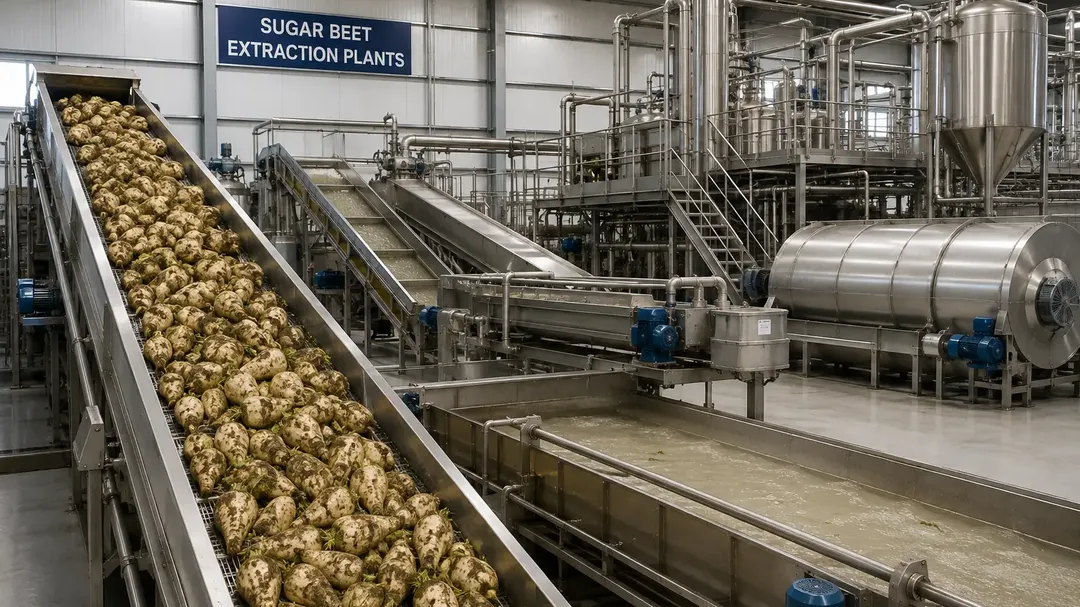
Sugar beet extraction plants utilize a series of specialized equipment for processing sugar beets into sucrose. These include cleaning stations, slicers, and diffusers to extract beet juice rich in sucrose. Subsequent steps involve clarification using lime and carbonation, followed by filtration and evaporation to concentrate the juice. Crystallization techniques then yield raw sugar, while advanced automation ensures precise control over each stage, optimizing efficiency and product quality.
A sugar beet extraction plant is an industrial facility built to process sugar beets — a root vegetable grown commercially for its high sugar content — and recover sugar from them. A typical plant brings together beet washing and slicing machines, diffusers or extraction towers, evaporators and crystallizers, which work in sequence to separate sugar from the beet juice, concentrate it and produce high-quality sugar crystals.
The process runs in seven stages. Cleaning washes and scrubs the beets to remove dirt, stones and other impurities. Slicing cuts the clean beets into thin pieces called cassettes. Extraction feeds the cassettes into a diffuser or extraction tower where they are mixed with hot water, dissolving the sugar and creating a sugar-rich juice. Purification removes impurities such as proteins and minerals, typically using a combination of chemicals and filtration. Concentration evaporates water to raise the sugar concentration. Crystallization cools and seeds the concentrated juice with sugar crystals to encourage new crystal formation, after which the crystal-and-syrup mixture is separated in a centrifuge. Drying then removes remaining moisture to give the final sugar product.
Sugar from these plants goes into baked goods, confectionery, beverages, dairy products and prepared foods. Sugar beet pulp, the byproduct of extraction, can be used as animal feed or as a source of bioenergy — an important consideration when planning byproduct handling and plant economics.
On the market side, a report by Market Research Future expects the global sugar market to grow at a compound annual growth rate (CAGR) of 4.22% from 2019 to 2024. Demand for sugar beet extraction plants is concentrated in regions with significant beet production and consumption — Europe, North America and Russia — while growing sugar demand in Asia Pacific, Latin America and the Middle East is expected to drive growth in those regions. Government subsidies and incentives for the sugar industry, along with regulations on environmental sustainability and labour practices, materially affect the profitability, competitiveness and operation of these plants. Key players in the market include Alfa Laval AB, BMA AG, DSEC Corporation, Fives Group, GEA Group AG and Thyssenkrupp AG.