
Molasses Desugaring Plants
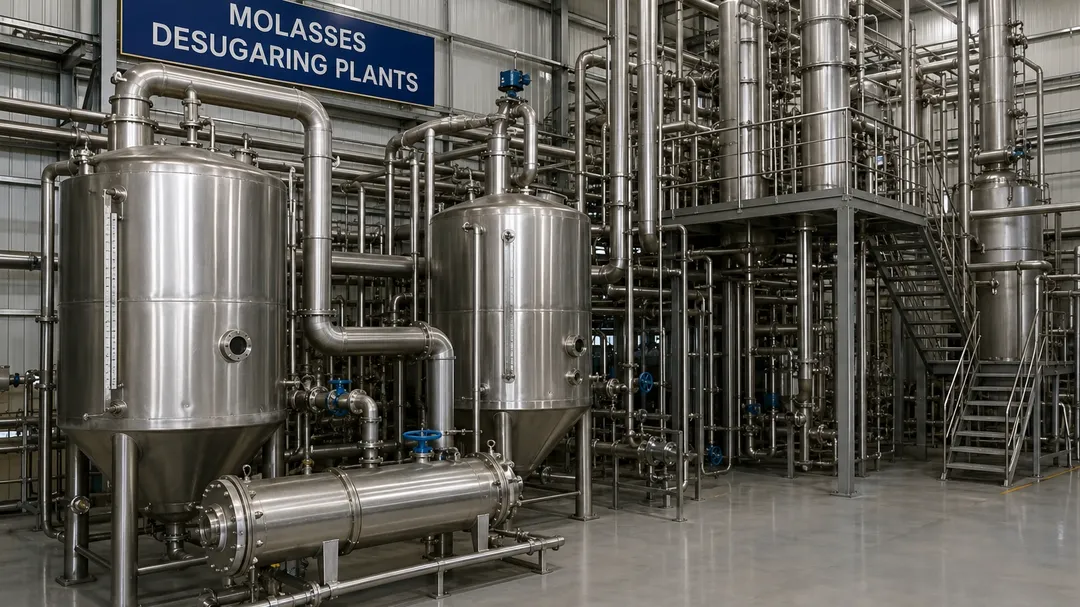
Molasses desugaring plants utilize advanced chromatography or membrane filtration techniques to extract sucrose from molasses, a sugar production byproduct. Through precise control of temperature, pressure, and flow rates, sucrose is selectively separated, yielding refined sugar and concentrated syrup. These plants employ sophisticated automation systems to monitor and adjust process parameters, ensuring high efficiency and purity, crucial for maximizing sugar production yield and quality.
Molasses desugaring plants are industrial facilities that process molasses, a byproduct of sugar production, to remove impurities such as sucrose crystals, organic matter and minerals. The molasses is treated with chemicals and/or filtered through various materials, and the resulting product is a clarified, concentrated molasses with a higher degree of purity and consistency — suitable for a wide range of industrial applications including the production of alcohol, yeast, animal feed, and other food and chemical products.
The process line typically runs in five stages. Pre-treatment neutralises any acids present using lime or another alkali and adjusts the pH to an optimum level. Clarification heats the pre-treated molasses and adds a flocculating agent so that impurities clump together and form sediment, which is removed by filtration or centrifugation. Decolorization uses activated carbon or another adsorbent to strip remaining impurities including colour pigments. Ion exchange resin columns then remove residual ash, minerals and heavy metals, and a final concentration step evaporates water to the desired level. Plants commonly employ ion exchange, carbon adsorption and ultrafiltration, and the exact configuration varies with the desired purity level and the specific requirements of the product.
Downstream, desugared molasses feeds bakery products as a natural sweetener, confectionery as a flavouring and colouring agent, beverages as a natural sweetener and flavouring agent, sauces, ketchup and other condiments as a key ingredient, breakfast cereals as a sweetener and flavouring agent, and animal feed for livestock and poultry.
Demand for these plants is driven by growing global consumption of alcohol including ethanol and biofuels, rising demand for animal protein and therefore feed-grade molasses, increasing interest in natural sweeteners as an alternative to refined sugar, and technological advancements that make higher purity and consistency achievable. Key players in the market include Alfa Laval AB, GEA Group AG, Bucher Industries AG and Veolia Environment SA.