
Sugar drying plants
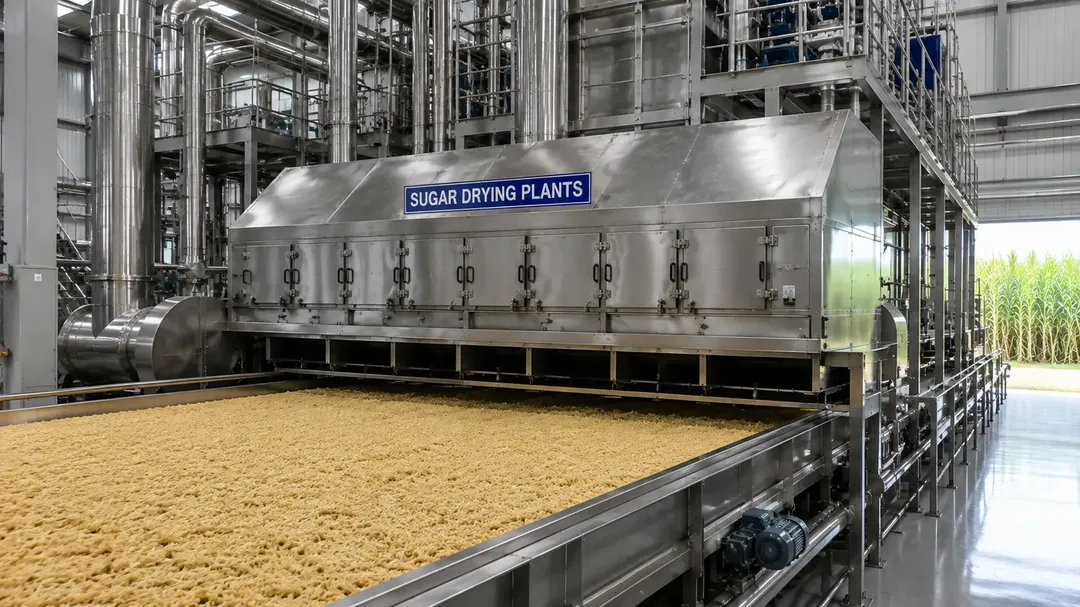
Utilizing advanced technology, sugar drying plants employ specialized equipment to meticulously extract moisture from sugar crystals, crucial for product stability and quality. Through precisely controlled air flow and temperature regimes, moisture is evaporated from the crystals efficiently. Innovative techniques such as fluidized bed drying or rotary drying maximize drying performance, while stringent quality control protocols ensure the resultant sugar meets exacting industry standards for purity and consistency.
A sugar drying plant is the industrial facility that removes residual moisture from sugar crystals to produce a dry, stable product fit for storage and transport. It sits at the final stage of sugar production, immediately after the crystals have been separated from the syrup in a centrifuge, and is used to produce granulated sugar, icing sugar and powdered sugar.
The working principle is straightforward but tightly controlled. Sugar crystals are fed into a drying chamber and exposed to hot air generated by a heater or boiler and circulated by fans or blowers. As the hot air passes through the crystals it absorbs moisture and carries it out of the chamber; the hot air and moisture are then vented, either through a dedicated vent or through the building's ventilation system. The dried crystals are cooled and screened to remove fine particles or impurities, leaving a dry, free-flowing sugar. Rotary drum dryers, consisting of a rotating drum heated from the inside, are the typical choice. Temperature and humidity of the hot air are carefully controlled so the crystals reach the desired moisture content without overheating or burning, and drying time varies with the incoming moisture content and the target moisture of the final product.
Drying matters to the sugar industry because moisture causes clumping, spoilage and mould growth. A properly dried product stays stable through transport and storage until it is used in food and beverage manufacture. Common downstream applications include baked goods, confectionery, beverages, dairy products and prepared foods.
Demand is being driven by the rising popularity of convenience foods, which need dry and stable sugar as an ingredient, and by growing interest in natural and organic foods calling for high-quality, minimally processed sugar. Increasing adoption of automation and control systems, along with newer technologies such as vacuum drying and spray drying, is expected to improve quality and consistency. The Asia-Pacific region is expected to be the fastest-growing market. Key market players include BMA, ThyssenKrupp AG, Fives Group, Bucher Unipektin AG, Andritz AG, Comessa, Yamato Sanko MFG. Co., Ltd, Heinkel Drying and Separation Group and Swenson Technology, Inc.