
Extruders
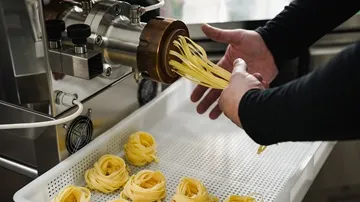
In food manufacturing, piping machines play a pivotal role in automating the precise deposition of batter, cream, or filling onto products. Leveraging advanced technology like servo-controlled pistons or rotary depositor heads, these machines ensure accurate and consistent dispensing. Programmable settings allow for customization of patterns and portion sizes, while precise controls maintain uniformity, optimizing efficiency and quality in food production processes.
Extruders are continuous, automated machines used in the food industry to process and shape food products. Raw materials — grains, cereals, fruits, vegetables and meat — are fed through a hopper and carried along a barrel by a rotating screw or auger, which compresses, shears and heats them. That combination breaks down starches and proteins into a homogenous mass, which is then forced through a die and cut to length by a rotating cutter. Typical outputs include snack foods, breakfast cereals, pasta, pet food and meat substitutes, in forms such as pellets, rods and tubes.
A full extrusion line follows a fixed sequence: feeding, mixing and heating (by friction and/or external heat from heating elements), pressure and shearing, shaping through one or multiple dies, cutting, cooling with air or water to reduce temperature and moisture content, and packaging for storage and distribution. Cooling and drying after shaping is what fixes the final texture and moisture level, so it deserves as much design attention as the barrel itself. The exact working principle varies with the type of extruder and the specific application.
Extruders are normally supplied with automation and control systems that give precise control of temperature, pressure and speed. For a manufacturer, this translates into increased production efficiency, consistent product quality and the ability to create unique shapes and textures — and because the machines are highly automated, they integrate readily into existing production lines.
Demand is being driven by rising consumption of processed foods such as snacks, breakfast cereals and pet food, by advances in extruder technology including twin-screw and co-rotating designs, and by sustainability goals: extruders allow by-products to be used and reduce the need for preservatives and additives. The Asia Pacific region, including China, India and Japan, is expected to be a major growth driver for the extruder market.