
Lactose processing
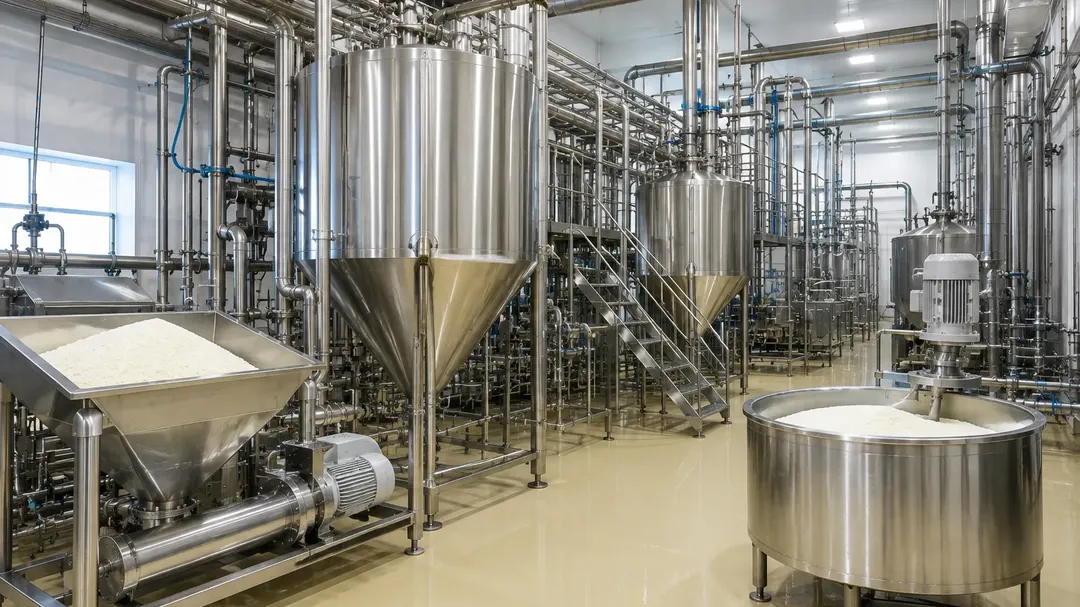
Lactose processing encompasses a series of intricate steps to extract and refine lactose from dairy sources, predominantly whey or milk. These processes often entail filtration to remove impurities, followed by evaporation and crystallization for lactose isolation. Advanced methodologies may employ enzymatic hydrolysis to degrade lactose into its constituent sugars, glucose, and galactose. The resultant lactose derivatives serve diverse applications across industries, including food, pharmaceuticals, and cosmetics.
Lactose is the primary carbohydrate in mammalian milk — cow's milk, goat's milk and human breast milk — and chemically it is a disaccharide made up of two simple sugar molecules, glucose and galactose. Lactose powder processing refers to the manufacturing route that turns liquid whey, a by-product of cheese manufacturing, into a dry, free-flowing lactose powder. For a dairy plant, this converts a high-volume side stream into a saleable product used across the food industry, the pharmaceutical industry, nutritional supplements, industrial applications and microbiological culture media.
The process line follows six stages. Whey is collected from cheese production facilities — the liquid remaining after milk has been curdled and strained during cheese-making. It is then filtered to remove impurities, proteins and fats, purifying the whey and isolating the lactose content. The filtered whey is concentrated to raise lactose content, using processes such as ultrafiltration or evaporation to remove water. The concentrated lactose solution is cooled and crystallized to form lactose crystals, typically by evaporating excess water and allowing the lactose to crystallize out of solution. The crystals are dried to remove remaining moisture, commonly by spray drying or drum drying, which produce a fine powder with good flow properties. Finally the powder is packaged in various sizes and formats for distribution to food and pharmaceutical manufacturers.
Membrane selection governs how cleanly the lactose is separated. Microfiltration uses membranes with pore sizes typically ranging from 0.1 to 10 micrometers to separate particles and components by size, and is often used to remove bacteria, proteins and fats from whey, leaving a clearer liquid. Ultrafiltration uses smaller pores, typically 0.001 to 0.1 micrometers, and is more effective at separating smaller molecules such as lactose while allowing water and smaller solutes through — it is commonly used to concentrate whey and isolate lactose. Nanofiltration works at typically 0.001 to 0.01 micrometers and is highly effective at removing smaller molecules including ions and some organic compounds. Reverse osmosis is a pressure-driven process using semipermeable membranes to separate water from dissolved solutes, and is highly effective at removing water to produce a concentrated lactose solution.
Nutritionally, lactose powder is almost entirely carbohydrate — primarily lactose, a disaccharide sugar — at approximately 375 calories per 100 grams. It carries less than 1 gram of protein, negligible fat, traces of calcium and phosphorus, and may contain small amounts of potassium and magnesium.