
Conductivity sensors help CIP systems detect solution strength and switch between reuse and drain, reducing water and chemical waste while improving cleaning efficiency.
Conductivity sensors help CIP systems detect solution strength and switch between reuse and drain, reducing water and chemical waste while improving cleaning efficiency.
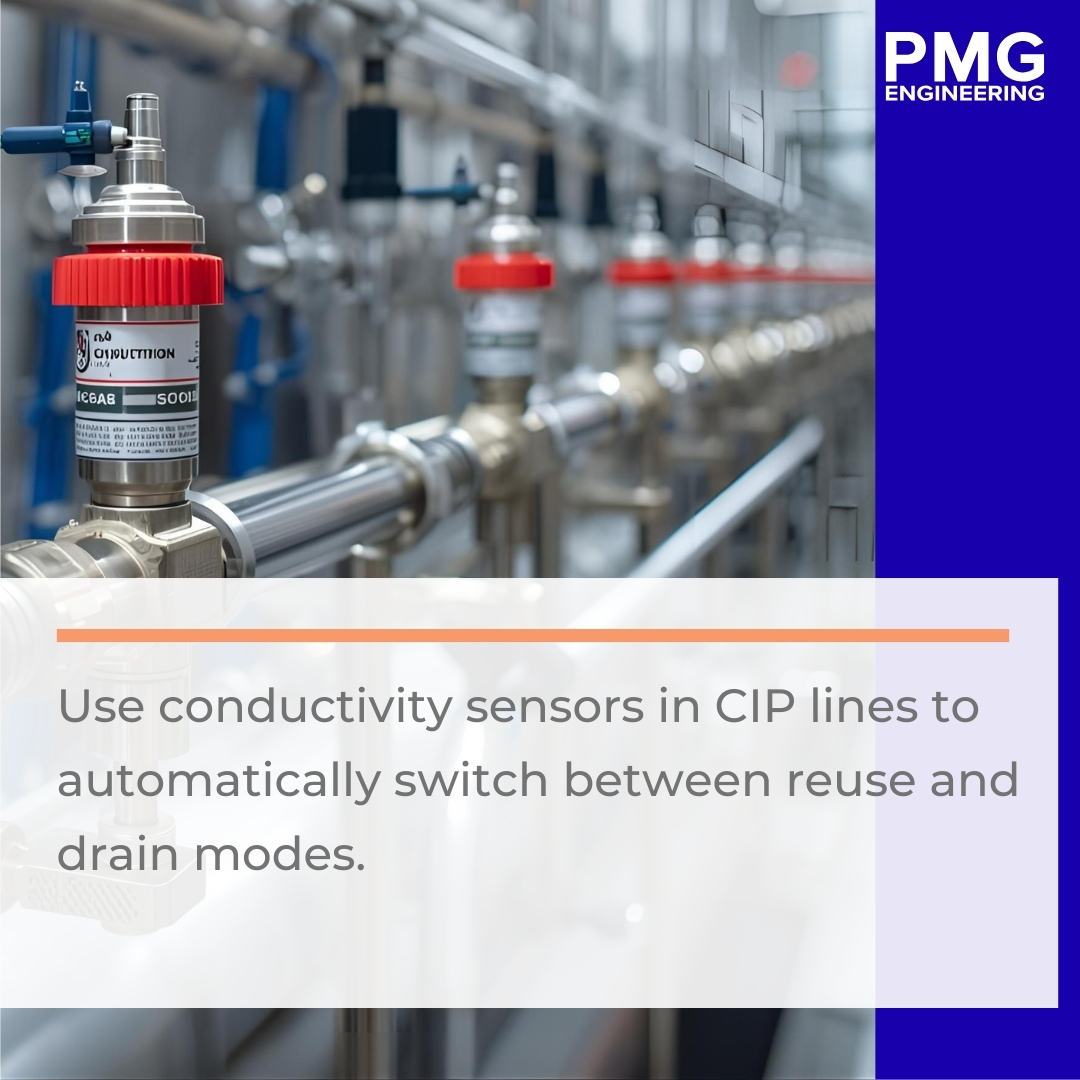
In a clean-in-place (CIP) circuit, the difference between a solution worth recovering and one that belongs in the drain is a matter of concentration — and concentration is what a conductivity sensor measures. Installing conductivity sensors in CIP lines lets the system automatically switch between reuse and drain modes, instead of relying on fixed timers or an operator's judgement at the panel.
For a food and beverage plant, that switching decision is where chemical, water and effluent costs are decided. Recovering detergent solution while it still carries useful strength, and diverting it once it is spent or diluted by the rinse interface, keeps recovery tanks clean and avoids sending usable chemistry down the drain.
Getting the benefit depends on where the sensors sit in the CIP return and how their signal is wired into the CIP sequence logic, so that the reuse and drain valves respond to measured conductivity rather than elapsed time.